Steady karate progress for a 7-year-old often looks like small improvements in movement, memory, class participation, and comfort rather than dramatic changes from one lesson to the next. A child may begin remembering more of a sequence, needing fewer reminders, recovering more quickly after mistakes, or moving with greater control as training becomes familiar.
For parents, those changes can be easy to overlook.
Adults often look for obvious milestones. They may expect progress to mean a new belt, a perfectly performed technique, or a child suddenly becoming much more coordinated.
Young martial arts students do not always improve in such visible ways.
At ages 6 and 7, progress often develops through many small moments that build on one another over time.
Progress Does Not Always Look Dramatic
One of the easiest mistakes parents can make is expecting each class to produce a noticeable breakthrough.
Some lessons may seem exciting because a child learns something new.
Others may involve repeating movements they have already practiced.
Sometimes a child may even appear less consistent than they were the week before.
That does not necessarily mean they are going backward.
Skill development is rarely perfectly linear. A child may remember a sequence one day and forget part of it during the next class. They may perform one movement smoothly but struggle with another that appears simpler.
Remembering Class Routines Can Be Progress
Parents sometimes focus almost entirely on karate technique.
However, for a young student, learning how class works is part of the process.
Early progress might include knowing where to stand, responding to instructions more quickly, understanding when to watch, or transitioning between activities with fewer reminders.
These behaviors can seem ordinary once a child is accustomed to them.
That is exactly why parents may stop noticing how much has changed.
Physical Progress May Appear in Small Details
Karate involves learning how to control the body in unfamiliar ways.
A 7-year-old may need time to coordinate the arms and legs, remember which direction to move, maintain balance, and follow a sequence at the same time.
Early progress may therefore be subtle.
A child might:
- Hold a position a little longer
- Step with better control
- Lose balance less frequently
- Remember which side to use
- Follow a combination with fewer pauses
- Move at a more controlled pace
- Recover more easily after making a mistake
None of these changes has to look dramatic to matter.
The child is building familiarity with movement.
Over time, those small improvements can make more complex instruction easier to understand.
How Can Parents Recognize Improvement in Memory?
Martial arts involves remembering instructions as well as performing them.
Parents may first notice that their child can describe more of what happened during class.
At the beginning, a child might say only:
“We did karate.”
Later, they may remember a specific movement, activity, or sequence.
They might be able to demonstrate the first few parts of something they practiced.
Eventually, they may recognize what comes next without waiting for the instructor to demonstrate every step again.
That does not mean the child will remember everything perfectly.
Martial Arts Progress Is Not the Same as Perfection
Young students can sometimes believe that progress means getting everything right.
Parents can unintentionally reinforce the same idea.
If the main question after every class is:
“Did you do it correctly?”
The child may begin to think mistakes cancel out improvement.
A more useful question might be:
“What felt easier today?”
That invites the child to notice change.
Maybe a movement still was not perfect, but they understood it faster.
Perhaps they remembered something without help.
Maybe they stayed with a difficult activity instead of giving up immediately.
Those are still signs that learning is happening.
What Does Progress Look Like in Martial Arts for 6-Year-Olds?
Six-year-olds may show many of the same types of gradual development, although some may need more reminders or shorter explanations.
Parents researching Martial arts for 6 year olds in Peoria may want to pay attention to whether the program is built around the learning needs of this age range rather than expecting younger children to train exactly like older students.
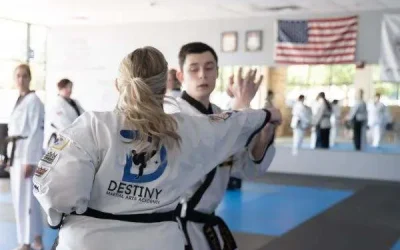
Destiny Martial Arts Academy’s Little Dragons program is specifically designed for ages 6 and 7.
For a 6-year-old, steady progress may look like remembering where to stand, listening through a complete instruction, following a basic movement more independently, or being willing to try again after forgetting something.
Confidence in the Routine Can Be Easy to Miss
A child who feels uncertain during early classes may spend considerable attention simply figuring out what is happening.
Where do they stand?
Who do they follow?
When do they move?
What happens if they make a mistake?
Once those questions become familiar, more attention can be directed toward learning actual karate skills.
Parents may notice this change when the child begins walking into class more comfortably or starts participating without looking toward a parent for reassurance.
Children May Improve at Different Skills at Different Speeds
Progress is rarely even across every area.
A child may have strong balance but need more repetition to remember sequences.
Another student may remember instructions quickly but need more time to coordinate the movements.
One may be comfortable demonstrating in front of others while another prefers to practice quietly.
Parents should avoid expecting improvement to appear in every area at the same time.
Instead, look at the overall picture.
Where has the child become more independent?
Which skills feel more familiar than before?
What now requires less help?
Those questions provide a more realistic view of development than expecting uniform improvement.
Comparing Children Can Hide Real Progress
Martial arts classes naturally place children near others who may be learning similar material.
That makes comparison easy.
A parent may see another student perform a skill confidently and wonder why their own child is still hesitating.
However, children do not begin with identical coordination, attention, prior activity experience, or comfort in group settings.
Two children can attend the same karate classes for 7 year olds and still progress differently.
The more useful comparison is between the child now and the child who first entered the program.
A Child May Be Improving Even When a Skill Looks Messy
Physical learning often looks imperfect before it looks polished.
A child may understand the basic order of a movement while still struggling with timing.
They may remember where the feet go but forget what the hands are doing.
They might perform the beginning smoothly and pause before the final step.
Parents should not mistake incomplete execution for a lack of learning.
Sometimes the child is already connecting several pieces but has not yet made them work together consistently.
How Should Parents Talk About Progress?
Specific observations are often more useful than broad praise.
Instead of:
“You’re amazing at karate.”
A parent might say:
“You remembered more of that sequence today.”
Or:
“You kept going even after you forgot one part.”
Or:
“You needed less help getting started this time.”
These comments draw attention to something the child actually did.
They can also help children recognize that progress is made through learning behaviors, not simply talent.
Parents can still celebrate larger milestones, but smaller improvements deserve attention too.
What If Progress Seems Slow?
Slow progress is not necessarily poor progress.
Some children need more repetition before a movement feels comfortable.
Parents should first consider the time scale they are using.
A child may look similar from one class to the next while showing a clear difference over several weeks or months.
Instead of evaluating every lesson individually, look for broader patterns.
Is the child more comfortable with the routine?
Are they remembering more?
Do they require fewer reminders?
Are they attempting skills with less hesitation?
These questions can provide a more useful picture than expecting obvious improvement every session.
If a parent remains unsure, speaking with the instructor can also provide additional context about what the child is currently working on.
Progress Can Include Better Responses to Mistakes
A child does not have to stop making mistakes to show improvement.
How they respond to mistakes may change.
Early in training, forgetting a sequence might cause a child to stop completely.
Later, they may pause, watch the instructor, and continue.
A difficult movement might once have caused immediate frustration.
After more experience, the child may simply reset and try again.
That change in response can matter.
The student is learning how to remain involved even when the first attempt does not work.
For young learners, that can be just as visible a sign of progress as performing a movement more smoothly.
What Should Parents Look for in Martial Arts Classes for 7-Year-Olds?
Parents comparing Martial Arts Classes for 7 Year Olds should consider whether the learning environment matches the child’s age.
Young students may benefit from clear instructions, repetition, opportunities to practice, and expectations that allow skills to develop gradually.
A program should not require children to behave like experienced martial artists from the beginning.
The child should have room to learn the class structure as well as the physical movements.
Age-specific programs can make those expectations clearer because the instructor is working with students who are closer in developmental stage.
For families in Peoria, Little Dragons karate programs designed around ages 6 and 7 can provide a clearer fit than placing a young beginner into instruction centered on much older children.
Belts and formal milestones may be visible markers, but they are not the only way to notice learning.
Parents can also pay attention to everyday changes.
Can the child remember a sequence they previously found confusing?
Are their movements becoming more controlled?
Do they understand instructions sooner?
Can they recover after making an error?
Do they arrive knowing what the class routine involves?
These changes can occur long before a major milestone is reached.
Focusing only on the next belt can make the learning happening between milestones easier to miss.
Consistency Can Make Progress Easier to See
Regular participation gives children repeated exposure to class routines and martial arts skills.
When children experience the same concepts more than once, unfamiliar movements can gradually become recognizable.
That does not mean every session will look better than the one before it.
Instead, consistency provides more opportunities to practice, receive instruction, and reconnect with skills that may still be developing.
Parents can support this by treating martial arts as an ongoing learning process rather than expecting a quick transformation after a handful of classes.
For children enrolled in Martial Arts Lessons for 7 Year Olds, progress is often built from repeated small experiences.
Steady Progress Is Made Up of Small Wins
A 7-year-old does not need to look like an advanced student to be making meaningful progress.
They may still forget things.
They may still need correction.
They may have days when balance, timing, or memory seem harder than usual.
What matters is whether more of the learning process is becoming familiar over time.
A child who now remembers two steps instead of one is progressing.
A child who can listen through an instruction that once required several reminders is progressing.
A child who makes a mistake, resets, and tries again is progressing.
For families exploring karate classes for 7 year olds in Peoria, recognizing these smaller changes can make it easier to understand what development actually looks like in an age-appropriate martial arts program.
Steady progress is rarely one dramatic leap.
More often, it is a collection of small improvements that eventually make yesterday’s difficult skills feel familiar.
About Destiny Martial Arts Academy
Destiny Martial Arts Academy provides martial arts instruction for children, teens, and adults in Peoria, Arizona, including age-specific programs for younger students. Their programs include Little Dragons for children ages 6 and 7, along with additional martial arts programs for other age groups. Families can Find their office on Google Maps for location details and directions.