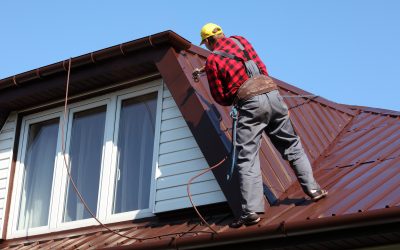
An open seam on a commercial flat roof can create a direct path for water to move beneath the membrane and into the roofing assembly. Because low-slope roof systems depend on sealed laps and transitions to create a continuous weatherproof surface, even a small seam separation deserves attention before moisture spreads beyond the original opening.
For property owners and facility managers, this is an important distinction. A flat roof can look largely intact from a distance while a narrow opening between membrane sections creates a localized vulnerability that may be difficult to connect to an interior leak.
What Is a Seam on a Commercial Flat Roof?
Many commercial flat and low-slope roofing systems use membrane materials installed in sheets, rolls, or sections.
Where adjoining pieces meet, they form seams or laps. These connections are designed to maintain continuity across the roof so that water remains above the membrane rather than reaching the insulation, deck, or other materials below.
Federal roofing guidance describes low-slope membrane roofing as a system in which laps and flashing must be completely sealed.
That makes seam condition especially important.
A broad membrane surface may perform as intended, but if one connection between adjoining sections opens or loses its seal, the roof no longer has the same continuous barrier at that location.
Why Are Seams So Important on Low-Slope Roofs?
Low-slope roofs manage water differently from steep-slope roofing.
On a steep roof, gravity moves runoff toward the eaves relatively quickly. Low-slope commercial roofs are designed with drainage in mind, but water generally moves across them more gradually.
Federal construction guidance defines low-slope roofs as weatherproof membrane assemblies and notes that they may be more likely to retain or pool water than steep-slope roofs.
This means membrane integrity matters across the entire roof.
Water reaching an open seam may remain near the defect long enough to find a pathway below the membrane, particularly if drainage is slow or the opening sits near a low area.
The presence of water does not automatically mean a seam will leak. Properly formed seams are designed to resist moisture. The concern begins when the seam is no longer functioning as intended.
How Can a Commercial Roof Seam Begin to Open?
There is no single cause behind every open seam.
The condition may involve material aging, movement, workmanship, traffic, environmental exposure, or nearby roof details.
Thermal Movement
Roofing materials change as temperatures rise and fall.
A membrane may expand and contract, while adjacent materials such as metal flashing, curbs, or the roof deck may respond differently.
Commercial roof systems are designed to accommodate expected movement, but stress can develop when materials or details no longer move together as intended.
Repeated movement may place pressure on seams, especially around transitions, edges, penetrations, and other areas where the membrane is restrained.
Loss of Adhesion
Some membrane seams rely on adhesives, tapes, heat welding, or other system-specific methods to create a watertight connection.
If the bond between adjoining sections becomes compromised, the edge may begin lifting or separating.
The underlying cause matters.
Simply pressing an open section back down without determining why it separated may not produce a lasting repair.
Roof Traffic
Commercial roofs frequently contain HVAC equipment, electrical components, vents, and other systems that require maintenance.
Technicians may need to cross the roof to reach them.
Repeated traffic near membrane seams can contribute to wear if the roofing is not adequately protected or if tools and equipment are placed on vulnerable areas.
An open seam near a mechanical service route should therefore be evaluated alongside surrounding membrane conditions.
Previous Repairs
Older patches or repair materials can also affect seam performance.
A repair may have addressed an earlier defect while introducing different material interfaces or localized stiffness.
If the repaired area later moves differently from the surrounding membrane, new stress may develop at its edges.
This does not mean previous repairs are inherently problematic. It means they should be included in any inspection of a recurring seam condition.
Are Open Seams Always Easy to See?
No.
Some are obvious, but others may be narrow enough that they are difficult to recognize without close inspection.
A seam may look slightly raised, curled, wrinkled, or irregular rather than dramatically separated.
Possible signs include:
- A lifted membrane edge
- A visible gap between adjoining membrane sections
- Wrinkling near a seam
- Cracking or deterioration along a lap
- Dirt accumulation at an opening
- Moisture staining near the connection
- An older repair beginning to separate
- Changes around flashing or penetrations near the seam
These signs do not automatically identify the source of an interior leak.
A visible seam defect and an interior moisture problem need to be evaluated together.
Why Can a Small Seam Opening Lead to a Larger Moisture Problem?
Water can spread after it gets below the membrane.
The original entry point may be only a few inches long, but moisture may move laterally through insulation or along the deck before becoming visible.
That means the affected area beneath the roof can extend beyond the seam itself.
This is one reason commercial roof leak diagnosis can be more complicated than simply finding the nearest visible defect.
A small seam opening may produce:
- A ceiling stain several feet away
- Damp insulation beyond the immediate seam
- More than one interior symptom
- Delayed dripping after rainfall stops
The extent depends on the roof assembly, insulation, slope, amount of water, and path available beneath the membrane.
How Does Drainage Affect an Open Seam?
Drainage can influence how much water reaches and remains near a seam.
Low-slope roofs are designed with positive drainage in mind, but changes in the roof surface, structural deflection, debris, or clogged drainage components can affect how quickly water leaves.
Historic federal roofing guidance has recommended minimum slope to promote drainage and warns that prolonged standing water can increase the effect of otherwise brief leaks.
An open seam in a well-drained area may experience different water exposure than one located beside persistent ponding.
That does not make drainage the cause of the seam failure, but it can make an existing defect more consequential.
For facility managers, recurring water near the same roof area is useful context during an inspection.
Why Does Phoenix Heat Matter for Flat Roof Seams?
Phoenix commercial roofs experience extended periods of intense solar exposure and high surface temperatures.
That makes repeated thermal movement an important consideration in roof performance.
Heat alone should not be treated as evidence that a seam will fail. Commercial roofing systems are designed for outdoor exposure and appropriate environmental conditions.
The issue is whether the membrane, seam, flashing, and attachment details continue accommodating movement as intended.
A seam that repeatedly opens after prior repairs may indicate that the area is experiencing movement or stress that was not fully addressed.
That makes the condition more than a cosmetic concern.
Can Wind Affect an Open Membrane Seam?
Yes.
Wind creates pressure across roof surfaces and is especially important at perimeters, corners, and other areas exposed to higher uplift forces.
The Whole Building Design Guide notes that membrane roof failures can begin when an opening at an edge allows wind to lift and peel roofing materials.
An isolated open field seam is not necessarily equivalent to an edge failure, but the principle is useful: once wind can act on an exposed membrane edge, the condition may become more serious.
That is another reason a lifted seam should not be dismissed simply because water has not yet appeared inside the building.
How Can Property Managers Tell Whether a Seam Is Actually Leaking?
They often cannot confirm it from appearance alone.
A commercial roof inspection may compare the visible seam condition with interior moisture locations and surrounding roofing details.
The evaluation can include:
- Membrane condition
- Seam integrity
- Flashing
- Roof penetrations
- Curbs
- Drainage
- Previous patches
- Adjacent roof areas
If an interior leak exists, its location can be mapped relative to the roof above.
However, as with other commercial roof leaks, the interior stain may not sit directly below the open seam.
Water may have traveled beneath the roofing before it became visible.
Can an Open Seam Be Repaired Without Replacing the Roof?
Often, a seam condition can be localized, but the appropriate scope depends on what caused it and what surrounding materials look like.
A small, isolated defect may require a very different response from widespread seam deterioration across a large roof area.
An evaluation may consider:
- The length of the open seam
- Whether adjacent membrane remains sound
- The condition of insulation below
- Whether the seam has been repaired before
- Whether similar problems exist elsewhere
- The state of nearby flashing
- Drainage around the area
- Material compatibility
A single open seam does not automatically mean the entire roof needs replacement.
Likewise, repeatedly repairing one seam without examining a broader pattern may overlook a larger condition.
Why Can Repeated Seam Repairs Fail?
Recurring failure often means the repair addressed the opening but not the reason it developed.
Consider a seam that is sealed repeatedly but continues to separate.
Possible questions include:
- Is the membrane moving excessively?
- Is the seam contaminated?
- Is the adjoining material deteriorated?
- Is the repair material compatible?
- Is water collecting in the same location?
- Is nearby equipment or traffic stressing the membrane?
- Is the original seam construction still sound?
The visible gap is only one piece of the diagnosis.
For that reason, commercial roof repair services should account for both the seam and the surrounding roof system.
How Does an Open Seam Differ From a Membrane Puncture?
Both can allow moisture beneath the roof, but they develop differently.
A puncture is generally a break through the membrane surface itself. It may result from dropped tools, sharp debris, equipment movement, or other physical damage.
An open seam occurs where two sections of roofing were designed to connect.
That difference matters because the repair approach should consider how the seam was originally constructed.
Simply treating every opening as a hole may ignore adhesion, welding, lap geometry, or other system-specific requirements.
What Should Be Included in Commercial Roofing Maintenance?
Seams should be part of a broader maintenance approach rather than the only focus.
A practical commercial roofing maintenance review may include:
- Membrane surfaces
- Seams and laps
- Flashing
- Parapets
- Roof penetrations
- HVAC curbs
- Drains and scuppers
- Roof edges
- Expansion joints
- Previous repair areas
Valley Roofing & Repair markets inspection, maintenance, leak detection, repairs, coatings, installation, and replacement for commercial properties, including flat and low-slope systems.
Property owners researching Commercial flat roofing in Phoenix can benefit from viewing seam condition as one part of that larger maintenance picture rather than waiting for an obvious interior leak.
How Often Should Seams Be Looked At?
There is no single inspection interval that fits every commercial property.
Roof age, system type, manufacturer requirements, building use, previous repairs, severe weather, and rooftop activity can all influence how often an evaluation is appropriate.
Additional inspections may also make sense after:
- Significant storms
- HVAC replacement
- New rooftop penetrations
- Solar or electrical work
- Construction activity
- A newly observed interior leak
The key is consistency.
A documented history makes it easier to determine whether a seam is stable or progressively changing.
What Should Facility Managers Document?
Good records can make future diagnosis much easier.
Useful information includes:
- Date an open seam was first observed
- Photographs of the area
- Interior leak locations
- Weather associated with leakage
- Previous repairs
- Rooftop equipment work
- Drainage conditions
- Any changes between inspections
If the same seam is photographed periodically, facility managers can see whether the opening is growing or whether a prior repair remains intact.
That can be more informative than relying on memory months later.
Should Maintenance Staff Seal an Open Seam Themselves?
Not unless they are trained and authorized to perform that work on the specific roofing system.
Commercial membranes are not interchangeable.
A material appropriate for one system may be unsuitable for another, and an improper repair can complicate subsequent work.
There is also the issue of roof safety.
Commercial roofs can include unprotected edges, skylights, slippery surfaces, electrical equipment, and other hazards. Access and repair work should follow appropriate safety requirements.
Facility teams can often provide the most value by documenting the condition and keeping unauthorized traffic away from the affected area until it can be evaluated.
When Does an Open Seam Become an Urgent Concern?
An open seam deserves faster attention when it is associated with:
- Active interior leakage
- Wet ceiling materials
- Widespread membrane lifting
- Significant separation
- Water accumulating near the opening
- Damage after a storm
- Electrical or operational concerns inside the building
Interior water near electrical systems or areas where materials may fall should be treated as a building-safety issue rather than simply a roofing inconvenience.
The condition of the roof can then be evaluated alongside any necessary interior safety measures.
Open Seams Are Small Defects With System-Level Consequences
Commercial flat roofs depend on continuity.
Membranes, seams, flashing, penetrations, curbs, edges, and drainage components must function together to keep water above the roofing system.
An open seam breaks that continuity at one of the connections between membrane sections.
The opening may remain localized, or it may allow water into insulation and other concealed materials. Its importance therefore depends not only on how large it looks but also on where it sits, why it opened, what is happening around it, and whether moisture has already entered the roof assembly.
For Phoenix property owners and facility managers, routine commercial roof inspection and maintenance can make these conditions easier to identify before the first obvious sign is a ceiling leak.
The most useful response is not simply covering every visible gap. It is determining why the seam opened, whether surrounding materials remain sound, and what repair will restore continuity to the roof system.