Simply put:
- Not all chimney damage can be patched — severe structural deterioration, persistent leaks, or a leaning stack often require a full rebuild rather than spot repairs.
- Knowing the difference between a repair and a rebuild saves Franklin, MI homeowners from repeated costs and safety risks.
A chimney rebuild becomes necessary when the masonry has deteriorated beyond what tuckpointing or isolated brick replacement can fix. For homeowners in Franklin, MI, Michigan’s harsh freeze-thaw winters accelerate that deterioration faster than many expect.
If you are weighing your options, a chimney rebuild in Franklin, MI is the appropriate scope of work when damage is structural — not cosmetic. Understanding exactly what pushes a chimney past the repair threshold helps you act before a partial problem becomes a full collapse.
How to Read the Warning Signs of Serious Chimney Damage
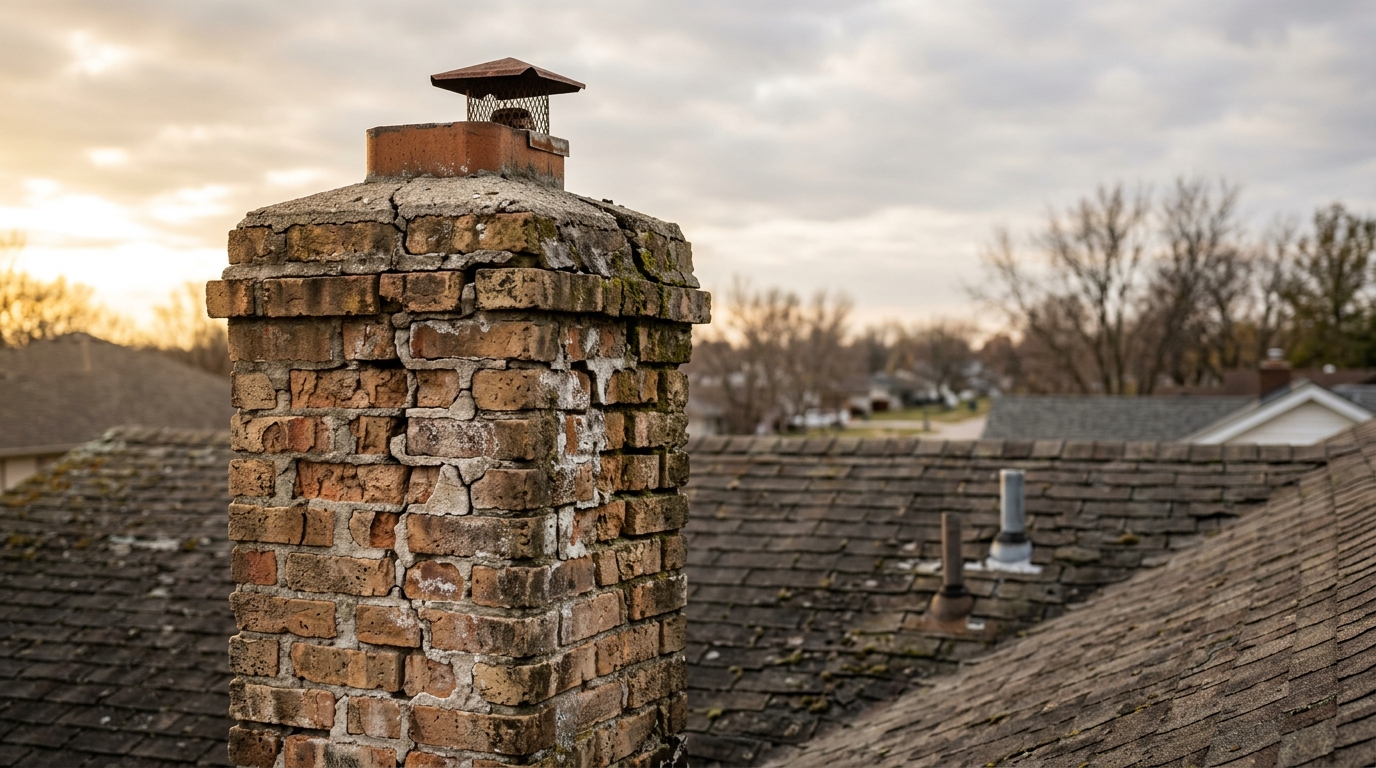
Signs requiring a rebuild include extensive cracking or spalling with large cracks, flaking bricks, or crumbling mortar compromising structural integrity; a leaning chimney creating serious safety hazards; severe water damage with persistent leaks, mold growth, or efflorescence; an extensively cracked or missing chimney crown allowing water infiltration; and widespread age-related deterioration in older chimneys that may not be repairable.
Michigan’s climate makes freeze-thaw damage especially common. The primary culprit is water or moisture entering small fissures and then expanding when it freezes, thaws, and refreezes — that expansion exerts pressure from within the mortar joint, intensifying and perpetuating the cracking over time.
Key warning signs to check from the ground:
- Stair-step or horizontal cracks running across multiple brick courses
- White stains on the masonry, which indicate water is penetrating and leaching salt out of the bricks
- A chimney that appears to be tilting slightly, or where the brick stack has shifted relative to the house, or where a gap is forming between the chimney and the home’s exterior
- Crumbling mortar joints that pull away from the brick face when touched
- A flat concrete or mortar cap at the very top of the chimney that shows cracks, chips, or missing sections
Repair vs. Rebuild: Choosing the Right Scope
Not every damaged chimney needs to come down. The table below outlines when each approach applies.
| Condition | Likely Solution |
| Receding mortar joints, no brick damage | Tuckpointing |
| Isolated spalled or cracked bricks | Selective brick replacement |
| Crown cracking, no structural shift | Crown repair or replacement |
| Multiple failed courses, leaning stack, widespread spalling | Full or partial rebuild |
There comes a time in the life of every chimney when its bricks and mortar finally wear out and it is no longer cost-efficient or safe to keep doing repairs. A professional mason can assess which category your chimney falls into after a close inspection — ground-level observation alone is not enough.
The National Fire Protection Association (NFPA) Standard 211 states that “chimneys, fireplaces, and vents shall be inspected at least once a year for soundness, freedom from deposits, and correct clearances,” and that “cleaning, maintenance, and repairs shall be done if necessary.” Following this schedule at the CSIA homeowner resources page gives you a framework for catching deterioration before it escalates.
How a Chimney Rebuild Works Step by Step
Once a rebuild is confirmed, the process follows a clear sequence:
- Inspection and scope assessment — A mason evaluates how many courses need removal and whether the foundation is sound.
- Demolition of damaged courses — Bricks are carefully removed down to stable, undamaged masonry.
- Flue liner evaluation — The liner is inspected and replaced or relined if compromised.
- Rebuilding with compatible materials — New bricks and mortar matched to the existing structure are laid course by course.
- Crown installation — A properly sloped crown is formed to direct water away from the flue opening.
- Sealing and flashing check — Flashing at the roofline is inspected and resealed to prevent water intrusion at the base.
A professional mason inspects the chimney to assess damage extent and determine rebuild scope before any bricks are placed. Skipping the inspection phase risks rebuilding over an unstable footing.
FAQ: Chimney Rebuilds in Franklin, MI
How do I know if my chimney needs a full rebuild or just tuckpointing? Run your finger across the mortar lines between your chimney bricks. If the mortar crumbles, flakes away, or has visibly pulled back from the brick face, that is the most common sign that tuckpointing is overdue. If the bricks themselves are cracked, spalling, or the stack is leaning, a rebuild is more likely the right call.
Is a leaning chimney an emergency? A leaning chimney can collapse without warning, especially during high winds or heavy snow load. If your chimney has a visible lean, do not use the fireplace and call a masonry professional immediately for a structural assessment.
How long does a chimney rebuild typically take? Most partial rebuilds on a residential chimney take one to three days depending on the number of courses removed and the complexity of the crown work. Full rebuilds from the roofline up may take longer.
Does Michigan weather affect how quickly chimney damage spreads? Yes. The primary culprit is water or moisture entering small fissures and then expanding when it freezes, thaws, and refreezes. In Franklin Township, where winters bring repeated freeze-thaw cycles, minor mortar gaps can become structural failures within a few seasons if left unaddressed.
Chimney damage rarely stays contained. What starts as a hairline crack in a mortar joint can widen into a structural problem within a few Michigan winters. Getting an inspection at the first sign of spalling, leaning, or persistent moisture is the most cost-effective step a homeowner can take. For masonry work in the Franklin Township area, Brickheads Masonry & Concrete Specialists LLC handles chimney rebuilds alongside a full range of brick and concrete services across Macomb County.