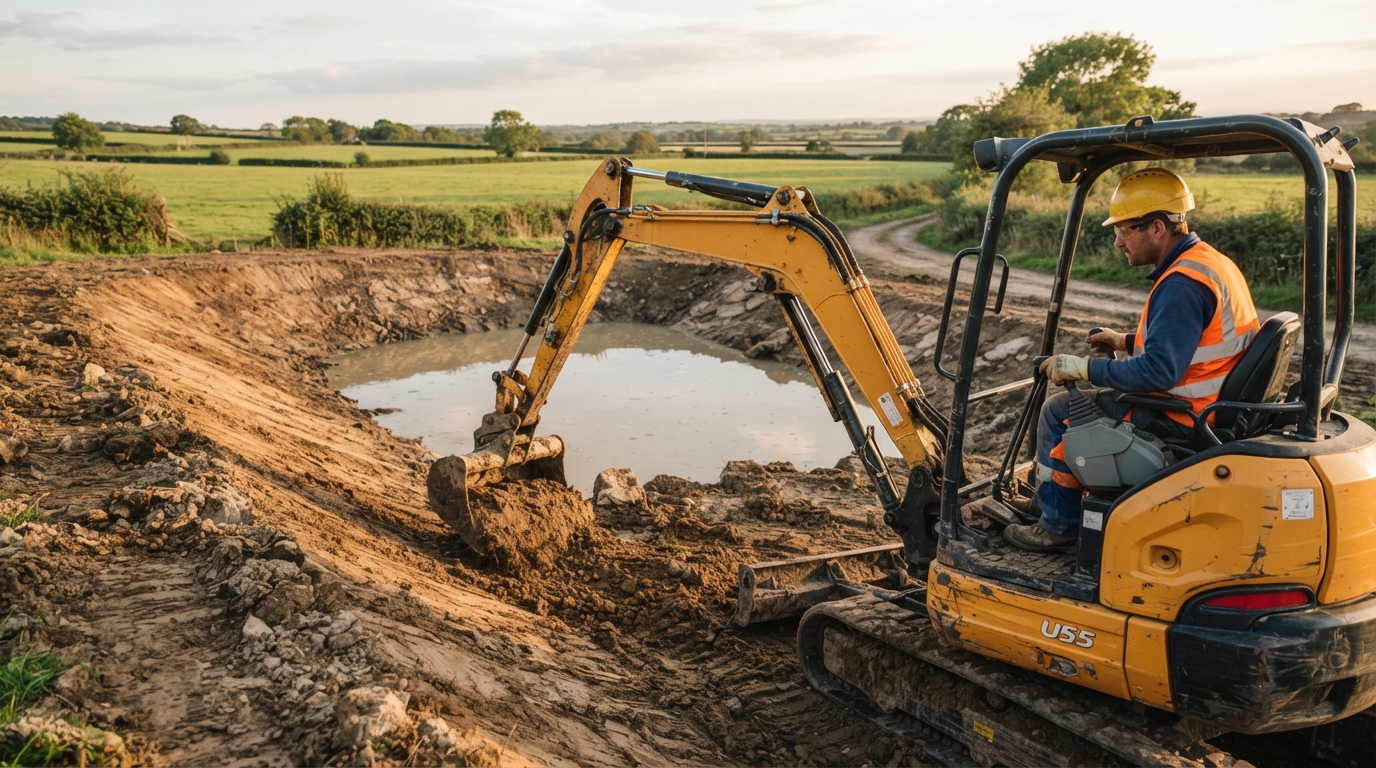
Briefly:
- A qualified pond contractor handles site evaluation, excavation, liner or clay compaction, and shoreline stabilization for new or restored ponds.
- Property owners in Newburgh, IN should confirm permit requirements, soil suitability, and erosion control plans before construction begins.
- Experience with both pond construction and drainage or grading work helps reduce long-term maintenance issues.
Selecting a qualified Pond Contractor means verifying that the company understands excavation, grading, and water management together, since a pond that is poorly sited or graded often develops erosion or drainage problems within a few seasons.
Property owners researching options can review Paulson Earthworks, a company whose listed service offerings include pond and lake construction alongside site preparation and grading work. Based in USA, the company serves property owners across Newburgh, IN for pond and related earthwork projects. Confirming that a contractor’s listed services match the scope of a specific project, rather than relying on general excavation experience alone, is a reasonable first screening step.
What a Pond Project Typically Involves
Building or restoring a pond is rarely a single-step task. Most projects move through distinct phases that each require different equipment and judgment calls.
- Site evaluation, including soil type, slope, and existing drainage patterns
- Excavation and grading to the designed depth and shoreline profile
- Compaction or lining to reduce seepage, depending on soil conditions
- Shoreline stabilization using riprap, retaining structures, or plantings to limit erosion
- Optional supporting work such as concrete access points or reinforcement near the pond edge
Property owners in Newburgh, IN should also expect a contractor to discuss outlet design and spillway placement, since uncontrolled overflow is a common cause of embankment failure in regional clay soils.
Permits and Local Requirements
Pond construction in Indiana is subject to oversight that varies by county and by project size. The Indiana Department of Natural Resources Division of Water reviews many construction activities on or near lakes, and a single state application form generally covers several related statutes. According to Indiana DNR, only one permit application form, State Form 42946 Permit Application for Construction, is needed when applying for a permit, though most projects under the purview of the Division of Water require a formal permit, while some projects may qualify for specific exemptions or general licenses.
Before any excavation begins, it is worth confirming:
- Whether the pond’s location falls within a floodway or regulated drain easement
- Whether total land disturbance will exceed one acre, which can trigger additional stormwater permitting
- Whether the project needs county-level review in addition to any state permit
A contractor familiar with these layers of review can usually flag likely requirements early, which helps avoid delays once equipment is mobilized.
Comparing Contractor Qualifications
| Factor | Why It Matters | Questions to Ask |
|---|---|---|
| Excavation and grading experience | Determines accuracy of depth, slope, and drainage flow | How many pond projects has the crew completed? |
| Erosion control methods | Affects shoreline durability over time | What stabilization materials are used? |
| Permit familiarity | Reduces risk of stop-work orders | Who handles permit coordination? |
| Equipment capacity | Affects project timeline and site access | What machinery is used for larger excavations? |
This table is a starting framework rather than a scoring system; the relative weight of each factor depends on pond size, soil type, and site access.
Frequently Asked Questions
How long does pond construction typically take? Timelines depend on pond size, soil conditions, and permit review periods, which can add several weeks before excavation starts.
Does every new pond require a permit in Indiana? Not always, but many projects do, particularly those near floodways, regulated drains, or exceeding one acre of disturbed land, so confirming requirements with local or state offices is advisable.
What causes most pond failures after construction? Inadequate compaction, poor outlet design, and insufficient shoreline stabilization are common contributors to erosion and embankment problems.
Can an existing pond be restored instead of rebuilt? Many ponds can be restored through dredging, shoreline repair, or liner replacement rather than full reconstruction, depending on the extent of damage.
Final Considerations
Choosing a contractor for pond construction or restoration involves more than comparing price quotes; it requires confirming that a company’s documented experience matches the specific technical demands of the project, from soil compaction to permit navigation. Current availability details for Paulson Earthworks are published for the local service area.